A good place to begin
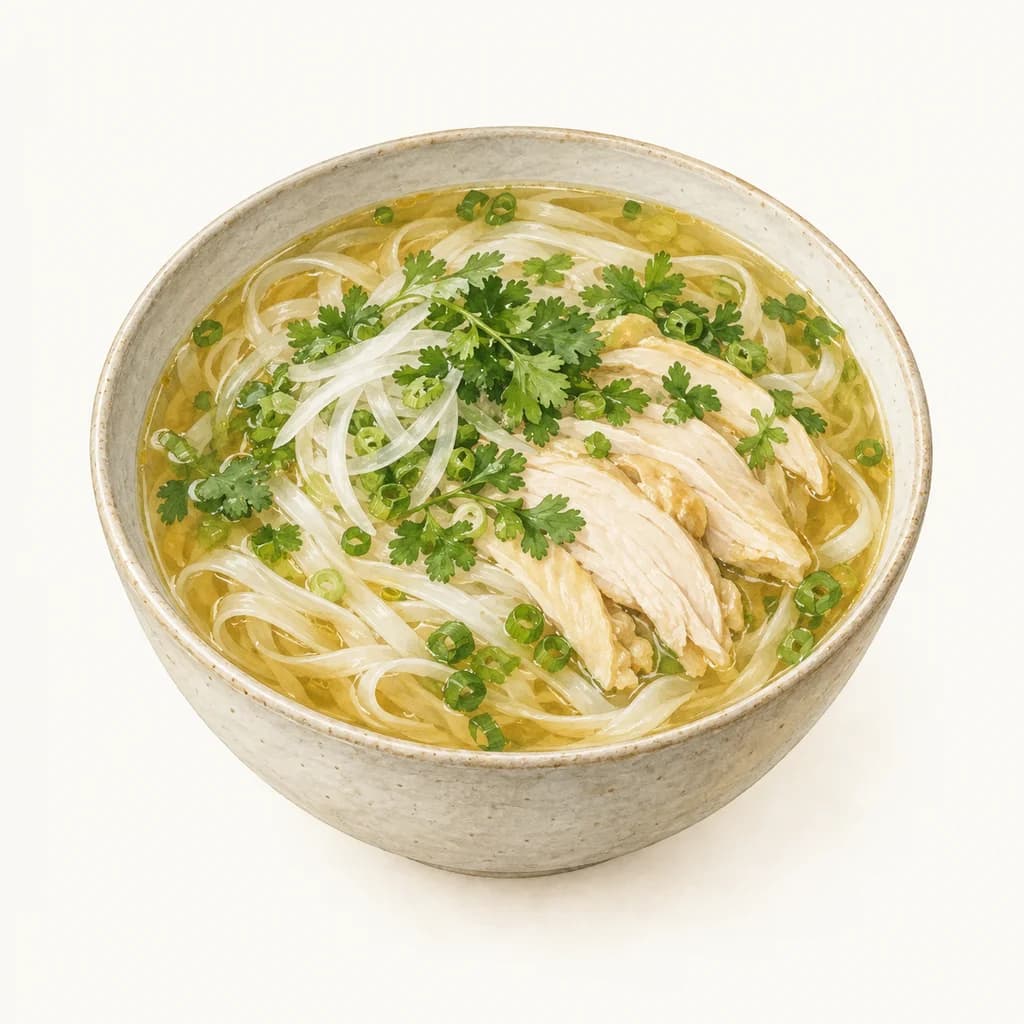
This Hanoi-inspired version keeps the bowl restrained: chicken, rice noodles, scallions, cilantro, and a ginger-led broth. It is an editorial interpretation, not a claim that every Hanoi cook makes pho the same way.
Compared with our flagship recipe, this smaller batch uses bone-in legs, omits sweet whole spices, and finishes with a little ginger and scallion rather than a large plate of herbs.
Why this recipe works
- Chicken legs provide meat and bones for a compact pot of broth.
- Coriander supports the chicken without the sweetness of cinnamon or star anise.
- Thinly sliced scallions bring freshness without overwhelming the broth.
Know your ingredients
Bone-in chicken legs work well for four servings. Use ginger in two stages: most in the stock, a small amount finely cut for serving. Start sparingly with the raw ginger, which is sharper than simmered ginger.
Substitutions that make sense
- Use bone-in thighs instead of leg quarters by weight.
- If cilantro is unwelcome, omit it and keep the scallions. Thai basil is optional at the table but changes the restrained garnish profile.
The recipe
Hanoi-Style Chicken Pho
A restrained Hanoi-inspired chicken pho with coriander, ginger, scallions, and a clear broth. A lighter garnish approach to phở gà.
- Prep
- 20 min
- Cook
- 1 hr 15 min
- Total
- 1 hr 35 min
- Serves
- 4
Equipment
Large stockpot · Heavy skillet · Fine-mesh strainer · Thermometer
Ingredients
For 4 servings. Check off ingredients as you cook.
Instructions
Prepare the aromatics
Brown onion and the larger piece of ginger in a dry skillet for 8 minutes. Toast coriander for the last minute. Cut the reserved raw ginger into very fine matchsticks and set it aside for serving.
Simmer the chicken
Put chicken and water in a stockpot and slowly bring to a simmer, skimming the surface. Add browned aromatics, coriander, salt, and sugar. Simmer gently for 35–45 minutes, until the thickest pieces reach 165°F / 74°C away from bone.
Separate meat and bones
Remove chicken to a clean tray. When safe to handle, pull meat into generous pieces and return bones to the broth. Simmer for 15 minutes more. Keep meat covered; refrigerate if it will wait longer.
Strain and balance
Strain without pressing the solids. Add enough hot water to bring the broth to about 7 cups (1.65 liters). Stir in fish sauce and taste. The broth should be savory and chicken-forward, not sharply salty.
Serve simply
Cook noodles separately according to their package. Divide noodles and chicken among four bowls. Add scallions, cilantro, and a small pinch of ginger matchsticks. Pour over hot broth. Offer lime and chili on the side.
Cook chicken to at least 165°F (74°C), measured in the thickest portion with a food thermometer, away from bone. For a whole bird, check the breast, inner thigh, and inner wing. Cooking times are estimates. More about food safety.
Small details, better results
- Cut the finishing ginger very finely; thick raw pieces can dominate a spoonful.
- Avoid adding every pho spice in the cupboard. The point of this bowl is a lighter aromatic profile.
- Take care with concentrated fish sauce: start with the measured amount and taste.
Bring it to the table
Serve with a small dish of lime and chili. Taste a spoonful of the plain broth before adjusting your bowl.
Storage and reheating
Divide leftovers into shallow containers and refrigerate within 2 hours (within 1 hour above 90°F / 32°C). Keep at 40°F / 4°C or colder for 3–4 days. Reheat chicken and broth to 165°F / 74°C. Store noodles and herbs separately; cook fresh noodles for the best texture.
Food safety reference: USDA guidance on leftovers
Questions from the kitchen
Does Hanoi-style pho always omit basil?
There is no single rule that describes every household or shop. This recipe uses a restrained garnish approach; it does not define a universal regional standard.
Why leave out star anise?
Omitting it makes this version distinct from the flagship bowl and lets chicken, coriander, and ginger lead.